Category Menu
Salinger
Catcher
Stories
Glass Series
Salinger Says
my reputedly heart-shaped prose has knighted me one of the best-loved sciolists in print since Ferris L. Monahan, and a good many young English Department people already know where I live, hole up; I have their tire tracks in my rose beds to prove it.)
- Seymour - An Introduction
About Dead Caulfields
Dead Caulfields was established in 2004 as an online resource focused on the life and works of J.D. Salinger. The site's exploration covers not only Salinger's classic novel The Catcher in the Rye, but also the author's lesser-known writings, published and unpublished ...
Contact
Salinger
An Inroduction
J.D. Salinger
Who Wrote Holden Caulfield?

Had there been any question in my mind that this site needed to be revised after the death of J.D. Salinger, that uncertainty was extinguished when I read through my previous version of this page: my "Salinger - An Introduction" page. It read completely in the present tense and implored the bizarre and the bored to allow Salinger the exercize of his liberty by affording him the freedom of privacy he so clearly desired - begging them to stop sneaking about Cornish, crawling up upon his lawn, ducking behind trees with zoom lenses and misplaced adoration in the off-chance that the author himself might miraculously be spotted, perhaps through his kitchen window while buttering his bread. Wouldn't the world be thrilled to know on exactly which side of Salinger's bread the legendary author preferred his butter? I'd say the *up* side, myself, but that's only an educated guess. To tell the truth, I've never even been to Cornish - something about making "the pilgrimage" has always creeped me out - so what do I know, really?
So, this page is compelled to re-evaluate its tenses. But I'm sorry to say that some form of the previous message must remain. Even now there are still those who insist upon crawling up upon the Salinger lawn, as if demanding of the author even in death some kind of payment for their own obsession, for an overly zealous fascination that Salinger never anticipated and always disdained. The new excuse is a search for hidden treasures: for Salinger's manuscripts, those writings supposedly produced by the author in the forty-plus years of his professional retirement (i.e. seclusion) that sat tantalizing and muzzled for decades awaiting the writer's tenacious grip on life to finally faulter, slip and relinquish. For these myopic "devotees", that day has come at last and it would not surprise me in the least to learn that one or two had doggedly located Salinger's resting place in the drooling hope that he had taken his manuscripts with him.
As for me, I'm going to go in the opposite direction: away from mourning, from speculation, gossip, and transitory voyeuristic curiosity. I'm no more satisfied that Salinger has been removed so that I can perchance read his post-career writings than I consider his death an opportunity to finally "set the record straight" now that the protective old sage is gone and therefore voiceless. "The record" had never struck me as being crooked before, especially when it came to those episodes of the author's life that best informed his writings. So, in place of "An Introduction to J.D. Salinger" I instead offer a story, a tale based on an account that Salinger himself told when he was a young man. I think it does the job:
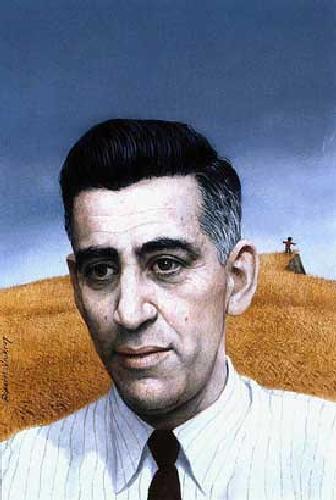
The train pulled out of Philadelphia, bound for New York. On board was a young man who had begun his trip earlier at Collegeville station, the small town where he went to school. He was nineteen – almost twenty, tall at six foot two, with hair and eyes so dark they were almost black. And he was thin, ‘angular looking', many had remarked, in a vaguely awkward way that left him awash in his otherwise stylish clothes. It was early December 1938, and the young man, an Ursinus College freshman named Jerry Salinger, was on his way home for the weekend. He was sitting alone on the train, contented - but not for long.
Just as the train car lurched forward, jostling back and forth as it picked up steam, an older man in an overcoat (a heavy garment generously decorated with assorted pet hairs) began to half squeeze - half shove his way into the empty seat next to Jerry, crashing into the young man's knees and repeatedly smacking his face with the open overcoat as he did. Once the man had finally wedged himself into place, he wasted no time. Instantly, he turned to his new neighbor (and judging from his expression, new best friend) and bestowed the broadest, most eager smile ever to light the Philadelphia to New York corridor. To Jerry, it was a smile that could mean only two things: his time alone on the train was about to suffer death by conversation and it was going to be a very long ride home indeed.
The man looked Jerry up and down. Then he asked if Jerry attended college. This was a bad position to be in, and Jerry knew it. Whatever he answered, it would give painful birth to a conversation he dreaded, with a man he'd rather not know. He had witnessed hours of insipid banter unfold countless times before – in just this very way. The kinder exchanges simply bored him. The more insistent ones irritated him to death. Cautiously, ever so cautiously, Jerry muttered that he was in fact in college.
‘Thought so', the man chuckled. ‘ Larry — that's my oldest boy— he goes to college too. Plays football. You play?'
It was a stupid question. Jerry no more looked like a football player than a Radio City Rockette. After confirming that he did not play football, the man again examined him from head to toe. ‘Well, I guess you need a little weight', he diagnosed, chuckling. The chuckling was starting to get on Jerry 's nerves.
But the conversation was not really about Jerry at all, and Jerry instinctively knew it. It was about the man's football-star son Larry, who Jerry soon learned was also an assistant scoutmaster and spent his free time walking old ladies across the street. Jerry was just there as a prop, something the man could brag at, compare his perfect son to, and use to inflate his own ego. Of all the empty seats on the Philadelphia to New York Line, he had chosen the seat next to the thinnest, most allergic to flying pet hair, most un-scoutmaster-like, or lady-can-I-help-you-across-the-street-type young man that he could possibly find.
Again, the man looked Jerry up and down. Still chuckling, he suggested (as if the idea had just dawned on him) that Jerry should gain weight. By now, Jerry was grinding his teeth. ‘Can you suggest a plan?' He implored sarcastically. ‘I refuse to eat breakfast foods.' The man became breathless. Perhaps Jerry could call his son, Larry . Surely, Larry could help even this bookish and emaciated boy. Larry could do anything. Larry was perfect.
For Jerry , this had to end. He was desperate. In a moment of brilliance, the kind of brilliance that shines clearest to those most exasperated, Jerry took the man into his deepest confidence. ‘You have been so kind that you don't deserve to be kept in the dark', he whispered. ‘The truth is, unfortunately, that for generations our family has suffered from beriberi'.
At Penn Station, Jerry and his traveling companion parted ways. There was no handshake. In fact, their conversation had declined into an occasional wary glance somewhere between New Brunswick and Jersey City.
In the years to come, the skinny young man on the Philadelphia to New York Line would be drafted into the army and serve with honor during the Second World War. Using his initials J.D., Jerry Salinger would go on to publish thirty-five short stories and four books. One of those books would be titled The Catcher in the Rye, universally recognized as a classic of American literature and among the most beloved novels of all time. The novel's main character, the iconic Holden Caulfield, would one day suffer a similar exchange on the very same train. Jerry never did gain weight. But he would one day be acclaimed among the great writers of the twentieth century. Daring to turn his back on the attention and wealth that fame offered, he would become a living legend, both admired and reviled for the singular path that he chose and for the principles he esteemed.
We don't know what happened to Larry.
Salinger, J.D. ‘Train Ride.' ‘J.D.S's, The Skipped Diploma', The Ursinus Weekly. Monday, 12 December 1938. p.2.