Category Menu
Salinger
Catcher
Stories
Glass Series
Salinger Says
“Don't you like Charlie Chaplin none?"
My sides was hurtingfrom laughing at Charlie.
Burke says, "He's all right. Only I don't like no funny looking littleguys always get chased by big guys. Never getting no girl, like. Fo rkeeps like."
- Soft Boiled Sergeant 1943
About Dead Caulfields
Dead Caulfields was established in 2004 as an online resource focused on the life and works of J.D. Salinger. The site's exploration covers not only Salinger's classic novel The Catcher in the Rye, but also the author's lesser-known writings, published and unpublished ...
Contact
Salinger
Allusions
also mentioned...but can you find them?
Salinger's stories allude to a number of famous people, some of whom he knew personally. Here is a short list of a few of them.
Often, the reader must search for the famous person behind the character.
Legendary Blues singer Bessie Smith is the basis of Salinger's character Lida Louise in his (published) 1948 story "Blue Melody". When Smith bled to death in 1937 of injuries suffered in an automobile accident, it was reported that she was denied admittance to the nearest hospital due to her race. This is a common tale told of several great persons of the period, not the least of whom was Dr. Charles Drew, the creator of blood plasma, who made transfusions possible. Although widely believed at the time, the accuracy of the Smith and Drew stories has since come into question. |
|
Salinger met Hemingway in France in 1944 while Hemingway was serving as a war correspondent and Salinger was in the Army Counterintelligence Corps and met later on at least one occasion during the battle of the Hurtgen Forest. In 1963, a now-famous story arose claiming that Hemingway had once shot a chicken (or duck, depending on the version) for Salinger's edification or amusement in the forest and that Salinger, mortified by the incident, relates it in "For Esme - with Love and Squalor," where the character of Clay shoots a cat. The truth behind that connection is debatable, but Hemingway is certainly "the gallant rogue" that Salinger compares himself to in a 1949 autobiographical contribution. Salinger and Hemingway's relationship was an odd one and their personalities somewhat polarized. Yet, Salinger initially thought Hemingway kind and was able to separate Hemingway's personal and professional personas. |
|
Often overlooked in Salinger's writings are numerous references to poet T.S. Eliot, especially Eliot's poem, The Waste Land . Salinger's 1948 story, "A Perfect day for Bananafish" quotes The Waste Land directlywhen Seymour Glass mentions "mixing memory with desire." The character of Sybil in the same story may also recall the preamble of Eliot's poem. Earlier, in his 1947 novella, "The Inverted Forest," Salinger rebuked Eliot's point of view with the following lines: |
|
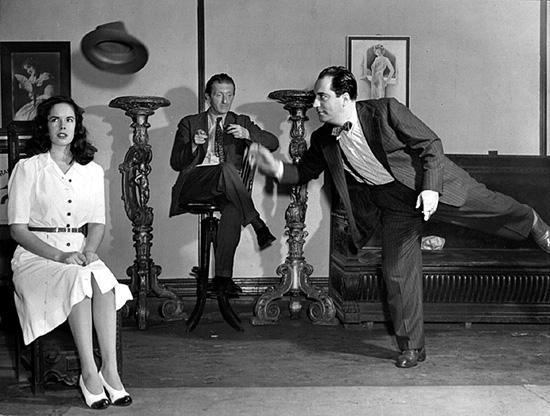
Ever wonder why Salinger's characters hate actors? In 1941, Salinger fell in love with the beautiful and sophisticated Oona O'Neill, the daughter of the famous playwright Eugene O'Neill (pictured with William Saroyan at top). They dated, and after Salinger entered the army in 1942, it is said that he wrote her voluminous letters on a daily basis. Oona's influence on Salinger's writings of this period can only be imagined. While J.D. was stationed in Georgia, Oona married Charlie Chaplin. Salinger was devastated. As a result, he detested Chaplin severely, calling him "an old prostate gland" and tainting his view of Chaplin's profession. If this reaction sounds harsh, it pales in comparison to the reaction of Eugene O'Neill, who never spoke to his daughter again. |
|
In 1939, Salinger enrolled in a poetry course at Columbia University taught by the famous poet-playwright Charles Hanson Towne. Towne had years before distinguished himself with multiple volumes of popular verse, many of which drew upon the streets and crowds of New York for inspiration. Salinger was not Towne's best pupil - or his favorite - but at semester's end, Salinger was gifted with a collection of Towne's work by his professor. Some might be tempted to search for Towne in the character of Raymond Ford, the tragic hero of Salinger's 1946 novella "The Inverted Forest", a comparison as hazardous as it is irresistible. |
|
In one of the most hauntingly beautiful excerpts of "Seymour: An Introduction," Buddy Glass recalls his brother Seymour riding the handlebars of "the redoubtable Joe Jackson." Jackson, also known as the "Tramp Cyclist," was a giant of vaudeville who travelled the world enchanting audiences with his trick bicycle act. Dressed as a hobo and gesturing in mime, Jackson would mount his bike and struggle to ride it as it slowly fell to pieces. In 1942, Jackson had just finished a performance at New York's Roxy Theater when he suffered a fatal heart attack. As he died, the sound of his grateful audience was still within earshot, and his last words were, "They're still applauding." His son, Joe Jackson Jr. took over the bicycle act upon his death, keeping it exactly as his father had performed it. Through their combined careers, Joe Jackson's nickel-plated trick bicycle delighted audiences for a hundred years. |
|
Author WP Kinsella did not publish his first novel until 1977, but his connection with Salinger's works is almost mystical. In 1982, Kinsella published his famous novel, Shoeless Joe which was made into the enormously popular movie Field of Dreams . In Shoeless Joe , the novel's main character, Ray Kinsella, kidnaps the reclusive Salinger who acts as an intermediary between the Kinsella family and the spirits of the long deceased 1919 Chicago White Sox, among whom is the ghost of Ray Kinsella's father. Respectful of Salinger's aversion to publicity, his name was changed for the movie. WP Kinsella readily admits to the enormous impact that Salinger's work has had upon him, including him in his novel as a tribute. If one examines Shoeless Joe and Field of Dreams with the Caulfield stories in mind, one recognizes the unmistakable connection in their messages. The mystical irony between the two authors lies in the amazing coincidence that Salinger included a Ray Kinsella in his 1941 story "A Young Girl with No Waist at All", and a Richard Kinsella in The Catcher in the Rye , long before WP Kinsella ever published a word. What are the chances? |
|
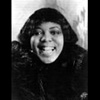 Bessie Smith
 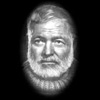 Ernest Hemingway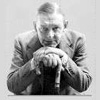
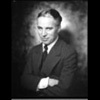 Charlie Chaplin
 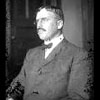 Charles Hanson Towne
 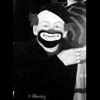 Joe Jackson